


The Sea Monk and Other Mythical Marine Creatures Vintage Illustration
The Sea Monk and Other Mythical Marine Creatures Vintage Illustration
Couldn't load pickup availability
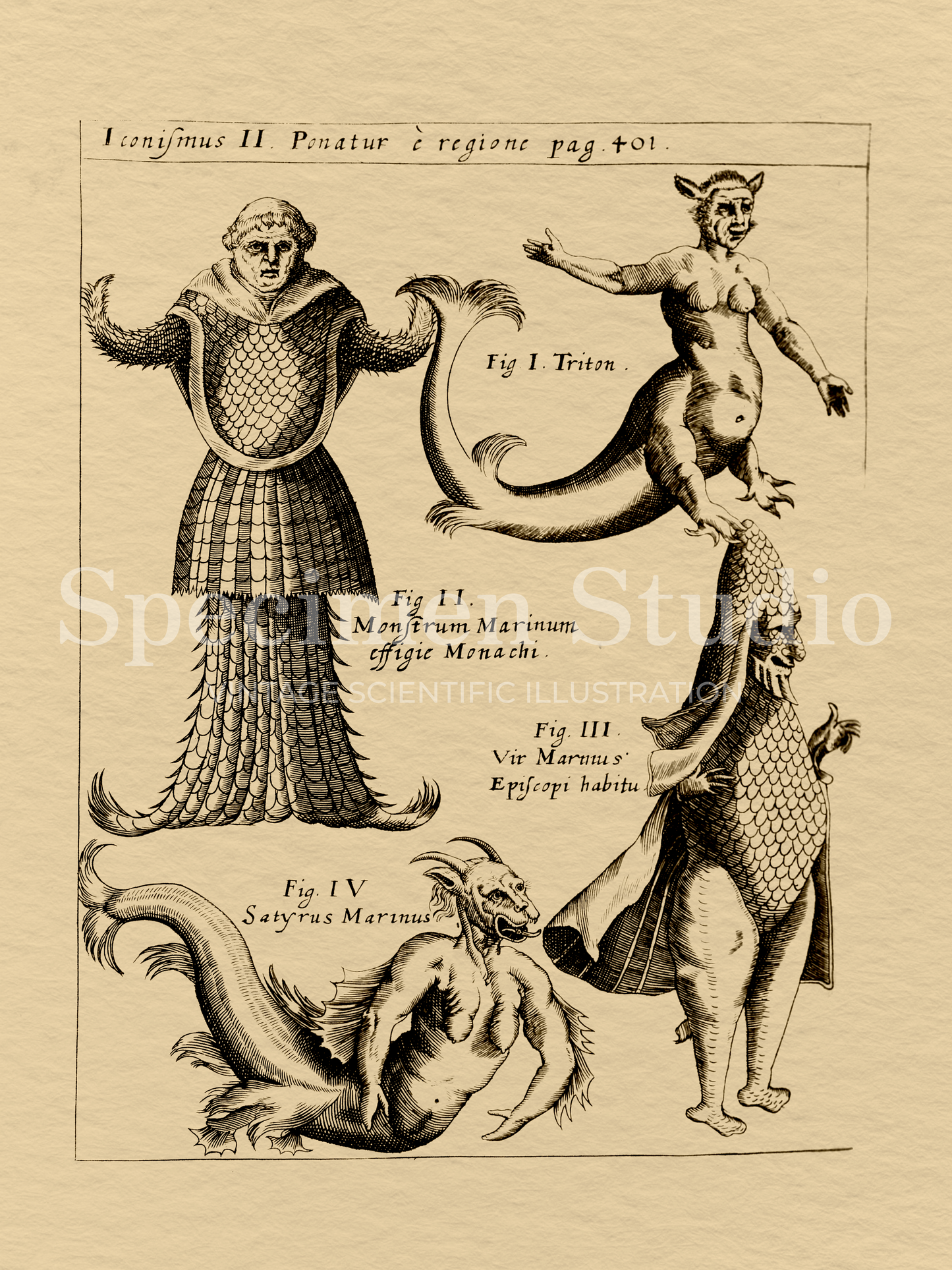
A vintage reproduction of Plate II from Gaspar Schott's Physica Curiosa (1662), a seventeenth-century encyclopedia by the German Jesuit scholar and scientist. The plate gathers four sea creatures Schott documented as real: a Triton, a sea monster in the likeness of a monk, a sea man in bishop's robes, and a sea satyr. Compiled from earlier naturalists like Gesner, Aldrovandi, and Paré, this is natural history caught mid-transition — the Scientific Revolution underway, but the deep sea still full of mystery.
Unframed Print:
- Size: 20x30 cm | 8x12 inch
- Print Details: 100% cotton, 308gsm fine art paper with archival, acid-free, premium coating that lasts generations. Vivid color saturation, rich black tones, and striking contrast that bring every detail to life. High-resolution giclée printing ensures exceptional detail, smooth gradients, and true-to-life colors.
Framed Print:
- Size: 21x30 cm | 8.5x12 inch
- Print Details: 100% cotton, 200gsm fine art paper with a velvety matte finish that eliminates reflections and adds a sophisticated, museum-style character to every print. Vivid tones and crisp definition. High-resolution giclée printing ensures exceptional detail, smooth gradients, and true-to-life colors.
- Frame Details: Crafted from durable wood for a sturdy yet lightweight frame that’s easy to mount and built to last. Crystal-clear plexiglass protects your artwork while offering safer, break-resistant durability compared to glass.
- Ready-to-Hang: Built-in brackets allow for quick, effortless wall mounting straight out of the box.
About the Illustrator: Gaspar Schott (1608–1666) was a German Jesuit, physicist, and natural philosopher, and a former assistant to Athanasius Kircher in Rome. A great compiler, he assembled Physica Curiosa from an extensive library of earlier scholarship — copperplate engravings of monsters, marvels, and mechanical curiosities, drawn from the work of 16th- and 17th-century naturalists. The engravers of the plates are largely unidentified, working under Schott's direction for the Nuremberg publisher Endter.
Share


Subscribe to our emails
Be the first to know about new collections and exclusive offers.